The Truth About the A90J OLED: Pros, Cons, and Verdict
In the rapidly evolving landscape of home entertainment, few technologies have commanded as much reverence as the Organic Light Emitting Diode (OLED). Among the giants of the industry, Sony has long maintained a reputation for prioritizing "creator’s intent"—the idea that a television should reproduce an image exactly as the filmmaker envisioned it. The Sony A90J OLED, part of the prestigious Master Series, represents a pivotal moment in this pursuit. It was the first to introduce high-brightness heat-sink technology to the Sony line, aiming to solve the one historical weakness of OLED panels: peak luminance.
For enthusiasts and cinephiles, the A90J is more than just a screen; it is a sophisticated piece of optical engineering. When it launched, it set a benchmark for what was possible with WRGB OLED panels, and even as newer technologies like QD-OLED have entered the market, the A90J remains a frequent point of comparison for its legendary motion handling and color accuracy. This article explores the nuances of this flagship display, examining why it remains a sought-after model for home theaters and where it might fall short for modern high-performance gaming.
Advanced Engineering: Under the Hood of the Master Series
The heart of the Sony A90J experience is the Cognitive Processor XR. Unlike traditional artificial intelligence that analyzes image elements like color, contrast, and detail individually, the XR processor attempts to mimic the way human brains perceive the world. It divides the screen into hundreds of zones and identifies where the "focal point" of a scene is—perhaps a character's face in a drama or a speeding car in an action sequence. By cross-analyzing these elements simultaneously, the processor enhances the focal point to provide a sense of depth and realism that feels natural rather than over-processed.
Another critical architectural feature is the integrated aluminum heat shield. OLED panels are sensitive to heat; sustained high brightness can lead to pixel degradation or "burn-in." By including a physical heat sink, Sony allowed the A90J to drive its pixels harder, reaching higher peak brightness levels than previous generations while simultaneously cooling the panel more efficiently. This engineering choice is what allowed the A90J to break the "brightness ceiling" that had previously limited OLEDs to dark room environments.
The Visual Experience: Contrast and Color Accuracy
When discussing OLED, contrast is the headline feature. Because each of the 8 million pixels can turn off individually, the black levels are truly absolute. In a scene featuring a starry sky, the stars shine with pin-point precision against a void-black background with zero light leakage or "blooming." This is where the A90J excels over even the best Mini-LED televisions, which still struggle with localized dimming artifacts around bright objects.
Color reproduction on the A90J is handled by the XR Triluminos Pro system. Sony’s philosophy tends toward naturalism. While some manufacturers opt for "neon" saturation that looks impressive on a showroom floor, the A90J favors accuracy. Skin tones look fleshy and varied rather than orange; forest greens look organic rather than radioactive. For viewers who watch a lot of high-quality 4K Blu-rays or high-bitrate streaming content from services like Sony’s own Bravia Core, the level of nuance in traditional SDR and HDR10 content is staggering.
Performance in Real-World Use Cases
Buying a flagship television is an investment, and most buyers want to know how the set performs across different types of media. The A90J is a versatile performer, but it clearly leans toward certain strengths.
Cinema and HDR Content
This is the A90J’s natural habitat. Supporting HDR10, HLG, and Dolby Vision, it handles the most advanced formats with ease. The A90J’s tone mapping is particularly noteworthy. When a movie scene contains highlights that are brighter than the TV can physically display, the XR processor skillfully manages the roll-off, ensuring that details in clouds or explosions aren't "blown out" or lost in a sea of white. The addition of the heat sink means that spectral highlights—the glint of sun on water or the flash of a chrome fender—have a visceral "pop" that was missing from older OLED models.
Sports and Motion
Sony is widely considered the industry leader in motion processing. Their XR Motion Clarity technology analyzes movement across several frames to ensure that action stays smooth, bright, and clear. For football, basketball, or hockey fans, this means the ball or puck doesn't "ghost" or stutter as it moves across the screen. Crucially, Sony achieves this without the dreaded "soap opera effect" (excessive smoothing) unless the user specifically adjusts the settings to that preference.
Find top-rated TVs & Home Theater products at great prices.
View Offers →Standard Definition and Upscaling
Not everything we watch is in 4K. Many broadcast signals, legacy cable feeds, and older DVDs are 720p or 1080i. The XR Upscaling on the A90J is remarkably effective at reconstructing lost textures and reducing digital noise. It makes legacy content look surprisingly sharp on a 55, 65, or 83-inch screen, which is a major factor for families who still watch a significant amount of cable television.
Acoustic Surface Audio+: The Sound of Innovation
One of the most unique aspects of the A90J is that the screen itself is the speaker. Using actuators located behind the panel, Sony vibrates the glass (imperceptibly to the eye) to produce sound. This creates a phenomenon where the audio actually originates from its location on the screen. If a character on the left side of the screen speaks, the sound comes from the left. If a jet flies across the screen, the sound tracks with it. This creates an immersive experience that most thin-panel TVs—which typically rely on tiny, downward-firing speakers—cannot match. While a dedicated home theater system is still superior, the built-in audio on the A90J is good enough that many users may find they don't actually need a soundbar for casual viewing.
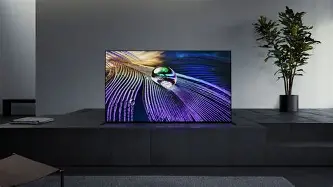
The Pros and Cons of the Sony A90J
While the A90J is a masterpiece of television design, no product is perfect. Depending on your specific needs—particularly for gaming or room lighting—there are trade-offs to consider.
- Pros: Masterful Picture Processing – The Cognitive Processor XR provides the most "human-like" and natural image on the market, with industry-leading upscaling.
- Pros: Class-Leading Motion Handling – Smooth, artifact-free motion makes it the best choice for sports and cinematic 24p film playback.
- Pros: Exceptional Build Quality – As part of the Master Series, the A90J features premium materials, a heavy-duty stand, and a backlit remote.
- Pros: Acoustic Surface Audio+ – The innovative screen-speaker technology provides a much better audio-visual synchronization than standard TV speakers.
- Pros: Deep Blacks and Infinite Contrast – The hallmark of OLED technology is perfectly executed here, with zero blooming.
- Cons: Limited HDMI 2.1 Ports – Only two of the four HDMI ports support HDMI 2.1 features (4K/120Hz), and one of those is the eARC port. If you have multiple next-gen consoles and a soundbar, you will run out of high-bandwidth ports.
- Cons: Risk of Burn-in – While the heat sink reduces the risk, all OLEDs are theoretically susceptible to permanent image retention if left on static news channels for thousands of hours.
- Cons: Out-of-the-Box Gaming Features – At launch, features like Variable Refresh Rate (VRR) required firmware updates, and it lacks some of the dedicated gaming "dashboards" found on competitors.
- Cons: Aggressive ABL (Auto Brightness Limiter) – In very bright scenes (like a snowy field), the TV may dim the overall brightness to protect the panel, which can be noticeable to some viewers.
Comparison: A90J vs. Competitors
To understand the A90J's place in the market, it helps to see how it stacks up against other high-end displays from the same era and subsequent technologies.
| Feature | Sony A90J (OLED) | LG G1/G2 (OLED) | Samsung QN90A/B (Mini-LED) |
|---|---|---|---|
| Panel Type | WRGB OLED w/ Heat Sink | OLED evo (WBC/WBE) | Neo QLED (Mini-LED) |
| Processor | Cognitive Processor XR | α9 Gen 4/5 AI | Neo Quantum Processor 4K |
| Smart TV Platform | Google TV | webOS | Tizen OS |
| HDMI 2.1 Ports | 2 Ports | 4 Ports | 4 Ports |
| Black Levels | Perfect (Infinite) | Perfect (Infinite) | Excellent (Minimal Blooming) |
| Peak Brightness | High (~750-900 nits) | Medium (~700-800 nits) | V. High (~1500+ nits) |
| Motion Handling | Industry Best | Excellent | Good |
Buying Guide: Is the A90J Right for You?
Choosing a television often comes down to the environment it will live in and the primary content it will display. The A90J is a specialized tool, and while it is excellent, it is not a "one size fits all" solution.
Consider Your Room Lighting
If you have a dedicated media room or a living room with controlled lighting (curtains and dimmable lights), the A90J will look spectacular. However, if your TV is positioned directly opposite a massive window that receives direct afternoon sun, no OLED can currently match the sheer "brute force" brightness of a high-end LED/LCD. The A90J’s anti-reflective coating is decent, but the absolute black levels are best appreciated when the ambient light is low.
Evaluate Your Gaming Needs
If you are a hardcore gamer with a PlayStation 5, Xbox Series X, and a high-end gaming PC, the A90J might frustrate you due to its port limitations. Because one of the two HDMI 2.1 ports is also the eARC port (used for soundbars), you essentially have only one "free" port for 4K/120Hz gaming if you are using an external audio system. For a casual gamer, this is a non-issue. For the "power user," it might require an expensive HDMI 2.1 switcher or an updated AV receiver.
The "Size" Factor
The A90J was released in 55, 65, and a massive 83-inch variant. One thing to note is that the 83-inch model offers a significantly more cinematic experience but requires a very sturdy piece of furniture or a professional wall mount, as it is considerably heavier than its smaller counterparts. The 83-inch variant is often the choice for those trying to replace a projector system with something that has better contrast and HDR capabilities.
The Google TV Ecosystem
The A90J runs on the Google TV platform. For users already in the Android or Google ecosystem, this is a major plus. It offers excellent voice search through Google Assistant, seamless casting from mobile devices, and access to arguably the widest library of apps. The interface on the A90J is snappy and responsive, thanks to the powerful internal hardware, which is a significant upgrade over the sluggish interfaces found on older "smart" TVs.
Find top-rated TVs & Home Theater products at great prices.
View Offers →The Impact of the Heat Sink Technology
One of the most discussed "truths" about the A90J is how much the heat sink actually matters. Enthusiasts often debate whether it is a marketing gimmick or a functional necessity. In practice, the heat sink serves two vital roles. First, it allows the TV to maintain high levels of brightness for a longer duration. Without a heat sink, an OLED will quickly dim itself once a certain temperature threshold is reached to prevent damage. The A90J can "hold" its peak brightness longer during a sunset scene or a long explosion, maintaining the impact of the HDR.
Second, the heat sink helps with "image retention" clearing. If you have been watching a movie with black bars on the top and bottom (2.35:1 aspect ratio), those pixels are off while the center pixels are on. This can create a temperature differential across the panel. The heat sink helps dissipate this heat evenly, allowing the pixels to "recover" faster once you switch back to full-screen content. This longevity-focused engineering is a hallmark of Sony’s Master Series approach.
Calibration and Out-of-the-Box Performance
Most consumers never calibrate their televisions, relying instead on factory presets. Sony is famous for its "Custom" mode, which is designed to be as close to a professional studio monitor (like the Sony BVM-X300 used in Hollywood) as possible. On the A90J, the Custom mode is remarkably accurate out of the box. For the average buyer, this means you don't need to hire a professional calibrator to get an image that looks "right."
Furthermore, the A90J features "Netflix Calibrated Mode" and "Bravia Core Calibrated Mode." When these are engaged, the TV automatically adjusts its settings to match the metadata of the stream, ensuring that you are seeing the image exactly as the colorists at the studios intended. It removes the guesswork of setting brightness, sharpness, and motion settings, which is a major convenience for those who want a "set it and forget it" experience.
The Verdict: A Masterpiece for Movie Lovers
The Sony A90J remains a landmark achievement in the world of television. While newer technologies like QD-OLED (Sony’s own A95K/A95L) and MLA (Micro Lens Array) have pushed peak brightness even higher, the A90J represents the pinnacle of the traditional WRGB OLED design. Its combination of natural color processing, absolute blacks, and incredible motion handling creates an image that feels "organic" and filmic.
Is it the right TV for everyone? Perhaps not. Hardcore gamers may find the two HDMI 2.1 ports limiting, and those with extremely bright, sun-drenched rooms might still find themselves wishing for the extreme luminance of a Mini-LED. However, for the person who treats movie night like a sacred event, who appreciates the fine details in a character's expression, and who wants a TV that feels as premium as its price tag suggests, the A90J is an exceptional choice. It is a television that doesn't just show you a picture; it tells you a story with the clarity and intent of the people who created it. The "truth" about the A90J is that it isn't just about the specs—it's about the emotional experience of viewing art in its purest digital form.
Ultimately, the A90J stands as a testament to what happens when engineering expertise meets a genuine passion for cinematography. It is a legacy piece from Sony's Master Series that will likely be remembered as one of the finest televisions of its era, continuing to provide a reference-quality experience for years to many who are lucky enough to have one in their living room.